Twelve years ago, in an interview, Palestinian master actor Saleh Bakri was asked whether we would ever see him in Palestinian cinema. Bakri replied:
“I want to be part of Palestinian cinema. I want to create something that belongs to me, something that belongs to us. But at the moment, there is no project on the horizon. Still, I’m sure it will come. Young people are incredibly active, and I am very hopeful about Palestinian youth.”
Twelve years have passed since then. Today, seeing Saleh Bakri on the big screen, this time in two powerful films at once is deeply moving. Witnessing how far Palestinian cinema has come is enough to bring tears to one’s eyes.
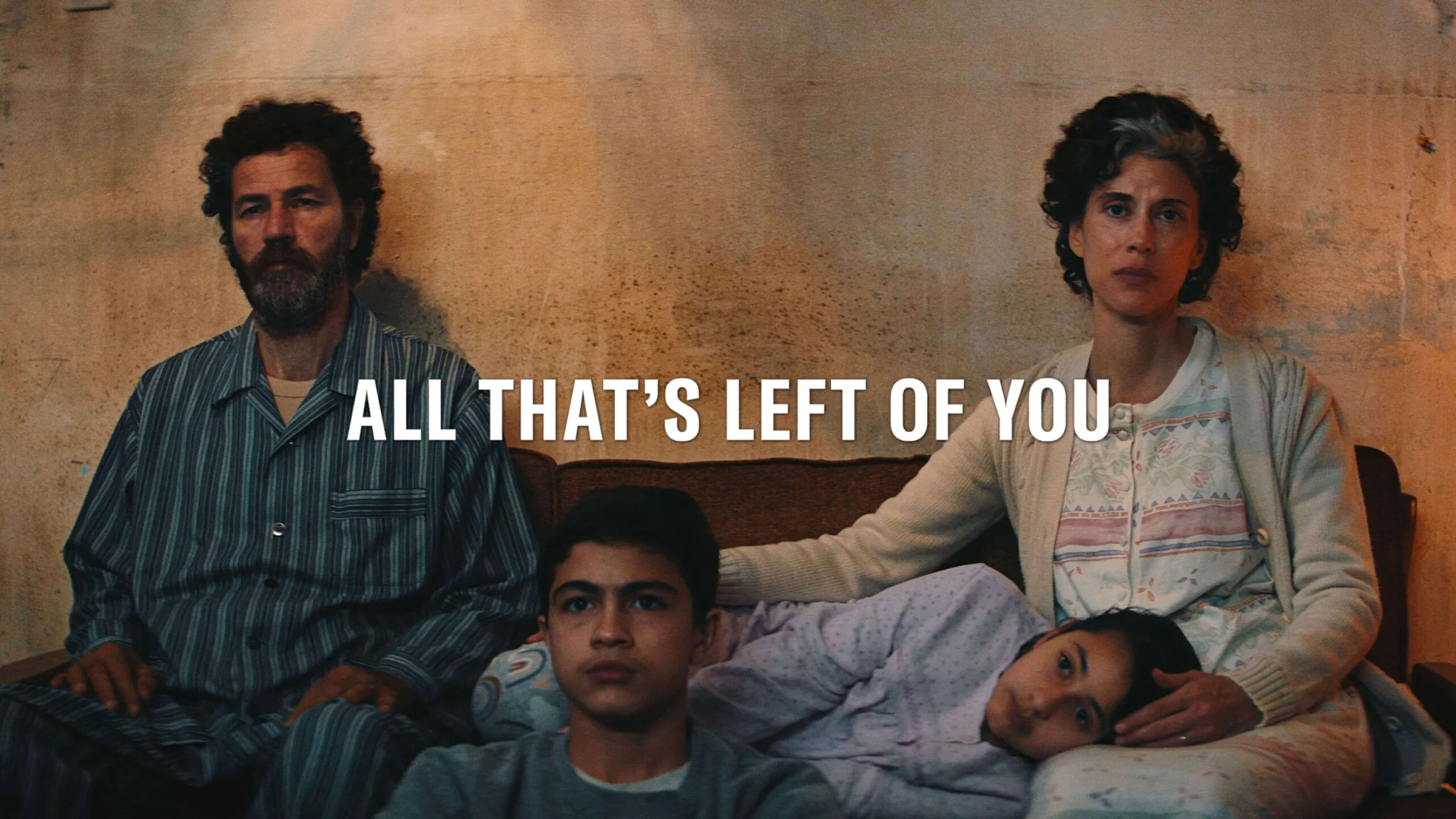
All That’s Left of You is one of these striking works. The film centers on the individual and collective traumas experienced by the Palestinian people and shows how these wounds are passed down across three generations. Societies often place a major historical catastrophe at the core of their collective identity, and this traumatic memory is transmitted from one generation to the next. Trauma thus becomes a foundational element of both family identity and social identity. Even those who did not directly experience the catastrophe internalize their parents’ memories as if they were their own. The new generation inherits a legacy that is both distant from the past and deeply enclosed by it.
In other words, an individual’s inner world and a society’s memory intertwine; one becomes the silent witness of the other.
Collective trauma represents a rupture far deeper and wider than an individual wound. War, forced displacement, massacres, loss, exile, oppression, and erased histories shape not only those who directly endure them, but also the emotional and psychological worlds of their children and grandchildren. In psychology, this is known as transgenerational trauma.
All That’s Left of You tells this very phenomenon by tracing the lives of three generations within a single family.
The story begins with Noor (Muhammad Abed Elrahman), a Palestinian boy wounded during a protest in the West Bank. His mother Hanan (Cherien Dabis) decides to take us back into the depths of the family’s past to explain how this moment came to be. In a strong yet fragile and resolute tone, we see Hanan speaking directly to the camera in close-up. We hear her words, but we don’t fully understand whom she is addressing until the very end of the film:
“You don’t know much about us. That’s okay, I’m not here to blame you. I’m here to tell you who my son is. But for you to understand, I need to tell you what happened to his grandfather.”
Her voice takes us back to 1948, to the Nakba. We are in Jaffa, witnessing Noor’s grandfather in his youth. We enter a peaceful, almost fairy-tale-like life surrounded by orange groves.
This segment is the first of the film’s four distinct time periods and marks the starting point of three generations. The grandfather Sharif (Adam Bakri) faces displacement and imprisonment as he tries to protect his orange orchard in Jaffa. His refusal to abandon his land powerfully reveals how deep one’s attachment to a place can be emotionally, existentially, and at the level of identity.
Forcibly expelled from their home, Sharif and his family become refugees. The narrative then moves to 1978, representing the second generation. Sharif’s son Salim (Saleh Bakri) is now an adult; his mother has passed away; and he lives in a cramped house with his father, wife, and children.
One of the film’s most harrowing scenes unfolds in this period. In front of Noor’s eyes, Salim is humiliated by Israeli soldiers, shattering Noor’s respect and trust in his father in an instant. This moment also becomes a symbol of a torch passed from one generation to the next the transmission of resistance, anger, and longing. While Salim carries the unresolved trauma of displacement and repression, Noor is drawn into protest under the shadow of his father and grandfather. Structurally, the film weaves personal stories together, creating an intimate family epic that brings political history and private history into dialogue.
After Noor is shot, the narrative shifts emotionally to another level, and the weight of this inherited psychological burden grows even heavier.
Watching three generations of the Bakri family in the same film is, in itself, a remarkable pleasure. Seeing Mohammed Bakri, known for Jenin, Jenin, one of the most important works of Palestinian cinema, on screen alongside his sons and grandson offers a truly unique cinematic experience. While the film spans 1948, 1978, 1988, and the early 2000s, it does not construct a narrative of passive victimhood; rather, it focuses on dignity, resistance, and confronting one’s own history.
At times, the storytelling leans toward an explanatory, almost didactic tone, but the overall flow remains strong and compelling. In the final section, the pace accelerates, and some key decisions are not explored as deeply as one might wish, leaving a slight sense of incompleteness. As someone who deeply values Palestinian cinema, these shortcomings did not trouble me greatly. There were moments when I thought, “Could this have been expanded a little more?” but considering the film’s runtime, it is understandable that the director had to make certain choices.
In just twelve years, the distance Palestinian cinema has traveled is powerful enough to shake even those who continue to turn a blind eye to the genocide in Gaza. There is one crucial point that Palestinian filmmakers and international directors standing in solidarity with Palestine never stop emphasizing:
“We draw our strength from the people of Gaza.”
Throughout history, cinema has been one of the most powerful tools for making the invisible visible, amplifying voices that must be heard, and leaving a visual memory for future generations. In recent years, we have witnessed with pride how this medium has become a vital instrument of resistance for the Palestinian people.
Films such as The Voice of Hind Rajab, Palestine 36, No Other Land, 200 Meters, The Present, Farha, Bye Bye Tiberias, The Teacher, and Once Upon a Time in Gaza stand among the strongest examples of how far Palestinian cinema has advanced. And for those of us who support Palestinian cinema, there is no greater joy than watching these powerful films on the big screen.