The words spoken about a person often reveal more about our own lives than theirs. The sentences shared after a loss are really a mirror for those left behind.
For the past twenty-four hours, social media has become exactly that kind of mirror. The same quotes are circulating on screens. The same sentences, the same expressions of respect, the same admiration.
Because a name has passed through this world: İlber Ortaylı.
There are countless words shared in his memory. But one stands out in particular; it’s as if everyone keeps sharing it because they’ve found a tiny truth about themselves in it:
"Life is very short. People, even if they are extraordinary, can leave at a young age. What truly matters is making a life, whose length we cannot determine, meaningful. Restless people cannot be productive. They destroy themselves and those around them."
Hearing these words shakes you gently.
It’s as if someone taps your shoulder lightly, pausing you for a moment amid the rush of life.
Because we all know: life really is short. But at the same time, we also know another truth. Most of us aren’t living the life we imagined. When we look back, our memory isn’t just filled with beautiful moments, it’s filled with growing stacks of “what ifs” and regrets.
How many of us truly do the work we love?
How many of us follow the curiosity we carry inside?
How many of us let getting lost in unknown cities, wandering new streets, and meeting new people become a natural part of our lives?
And a tougher question:
How many of us can dedicate more time to a child’s laughter, the pages of a book, the silence of a forest, or just closing our eyes over a cup of coffee, than to the hours we scroll through social media?
There’s a strange distance between the life we live and the life we envision.
We have a life we say we want to value but most often, it’s filled with moments we can’t even muster the energy to pursue. And most of those moments dissolve into the hours we spend without real care.
When we speak of valuing life, are we really living it, or are we merely watching it from afar? As these thoughts wandered through my mind, I came across a film last night: Train Dreams.
This isn’t a film about grand stories. There are no brilliant victories, no loud heroics, no long speeches. But there is a life. The life of an ordinary man. And from that life rises a profound silence. At the center of the film is a man named Robert Grainier, a railroad worker in the vast forests of the American Northwest. He lays tracks, cuts trees, builds railway lines. An orphan, quiet, unassuming, an ordinary man without grand thoughts.
The film tells his life story, but not like a conventional biography. It moves more like the memories of a lifetime. Time here doesn’t rush. It doesn’t hurry. It flows with a patient rhythm, like a train slowly moving along the tracks.
One day working.
One day returning home.
One day falling in love.
Then a moment when life fractures. The second half of the film unfolds in the shadow of a profound loss the feeling of loss we all somehow know. But the film doesn’t scream pain. It drifts it slowly through the scenes, almost like the wind. Because life often moves this way, not with noise, but with silent erosion.
Watching, you begin to think of your own life.
Don’t we all live our pain this way? The initial screaming, burning feeling eventually gives way to a quiet weight. And then we learn to live with that weight. Pain eventually settles into memory. We learn to carry it in the deepest part of our hearts.
Just like Robert.
And perhaps just like in the words İlber Ortaylı reminded us of repeatedly throughout his life. At some point while watching the film, you realize: this film isn’t just about one man’s life, it’s about time itself.
How it wears us down.
How it transforms us.
How it accumulates.
Robert Grainier’s life seems distant at first glance. But on closer look, it carries a familiar echo.
His solitude was among the forests.
Ours is among crowded screens.
He listened to the wind.
We listen to notifications.
But the result often leads to the same place: the moment we realize we’ve quietly slipped away from life. It’s here that İlber Ortaylı’s words regain their meaning:
"What truly matters is making a life, whose length we cannot determine, meaningful."
Life’s length is truly uncertain. No one knows which curve might be the last. Yet, many of us live as if life were an endless draft.
We postpone reading.
We postpone traveling.
We postpone curiosity.
Life feels like preparation for a great story that will begin in the future.
Until one day, as we age, we look in the mirror and notice our bodies can no longer move as swiftly, and we realize: the days ahead are fewer than those behind us.
This is the striking part of Train Dreams.
Robert’s life isn’t spectacular. But it is real. Quiet, yet authentic.
Today, thousands of people are sharing İlber Ortaylı’s words on social media. Everyone talks about the brevity of life, about living boldly, creating, being curious… But there’s another truth. Our fingers scroll endlessly on screens. Hours pass unnoticed.
If we pause and ask ourselves: when we compare the time spent with our family to the time spent on screens, which outweighs the other? When we compare the number of books we read in a year to the short videos we watch, which takes up more space?
What is the difference between the cities we visit and the screens we see?
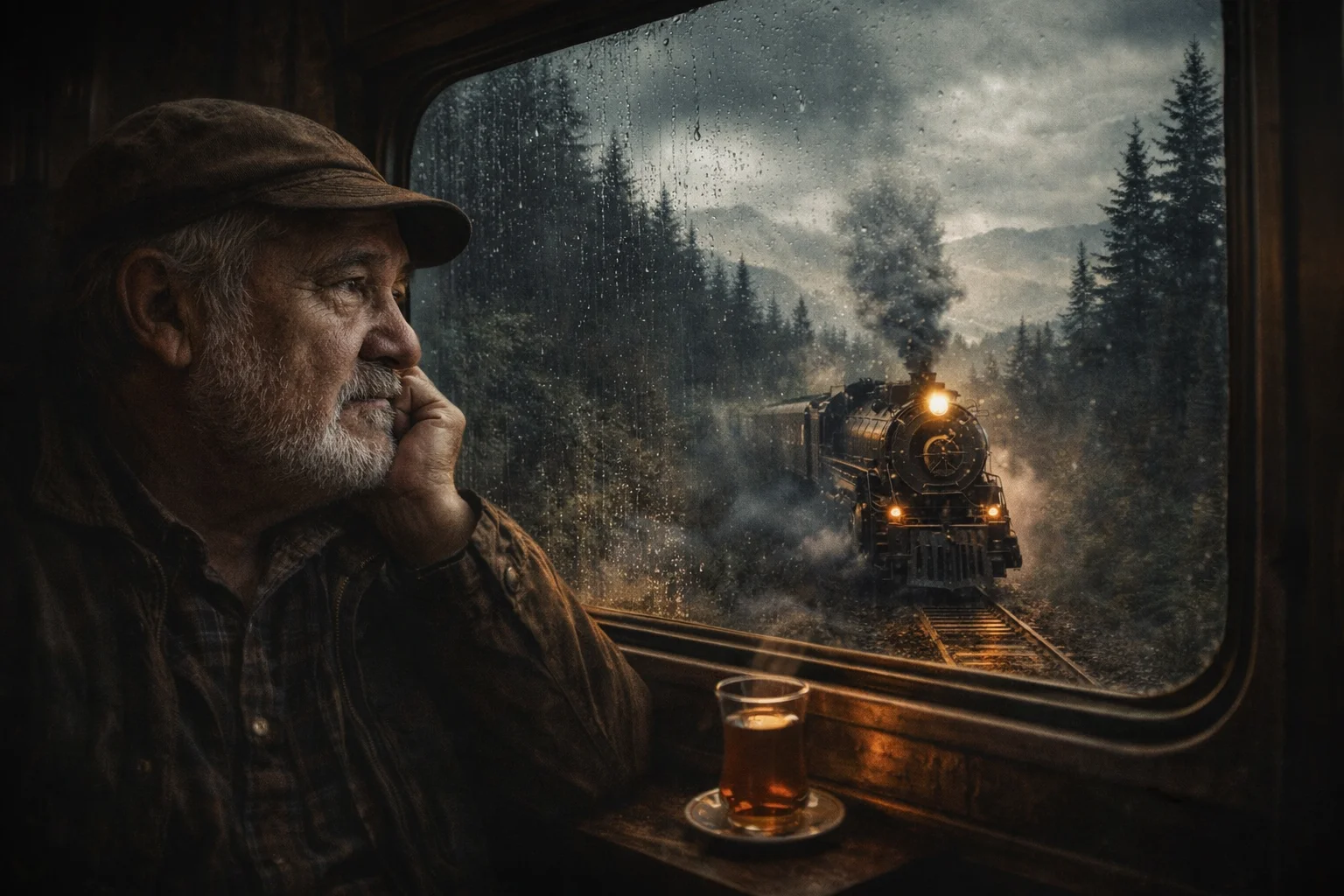
Life is rarely a grand novel. It is more often a quiet journey. Like a long train moving along the tracks.
That train doesn’t rush. But it doesn’t stop. Sometimes we lean against the window, thinking we are watching the scenery, unaware that the scenery has long passed behind us.
This is why İlber Ortaylı’s words aren’t just a beautiful quote, they are a compass:
"Restless people cannot be productive."
Because we live in a restless age.
Everything is fast.
Everything is bright.
Everything is fleeting.
But depth requires patience. Curiosity requires time. Looking at İlber Ortaylı’s life, you see this: the patience of curiosity.
To get lost in a book.
To learn a city’s history, street by street.
To spend years understanding a culture.
Perhaps a meaningful life is built exactly like this. Quietly. Unshowily. But with profound purpose.
Just like the train in Train Dreams.
The train slowly moving on the tracks carries all of our lives.
One day we wake.
One day we love.
One day we lose.
And that train eventually reaches its final station. Looking back, what remains in our hands is often simple:
A few books.
A few cities.
A few friends.
A few memories.
And perhaps one question: This life was given to me…
Did I truly live it, or did I merely watch the passing scenery from the train window?